Buying a Peptide Pen: What Really Matters
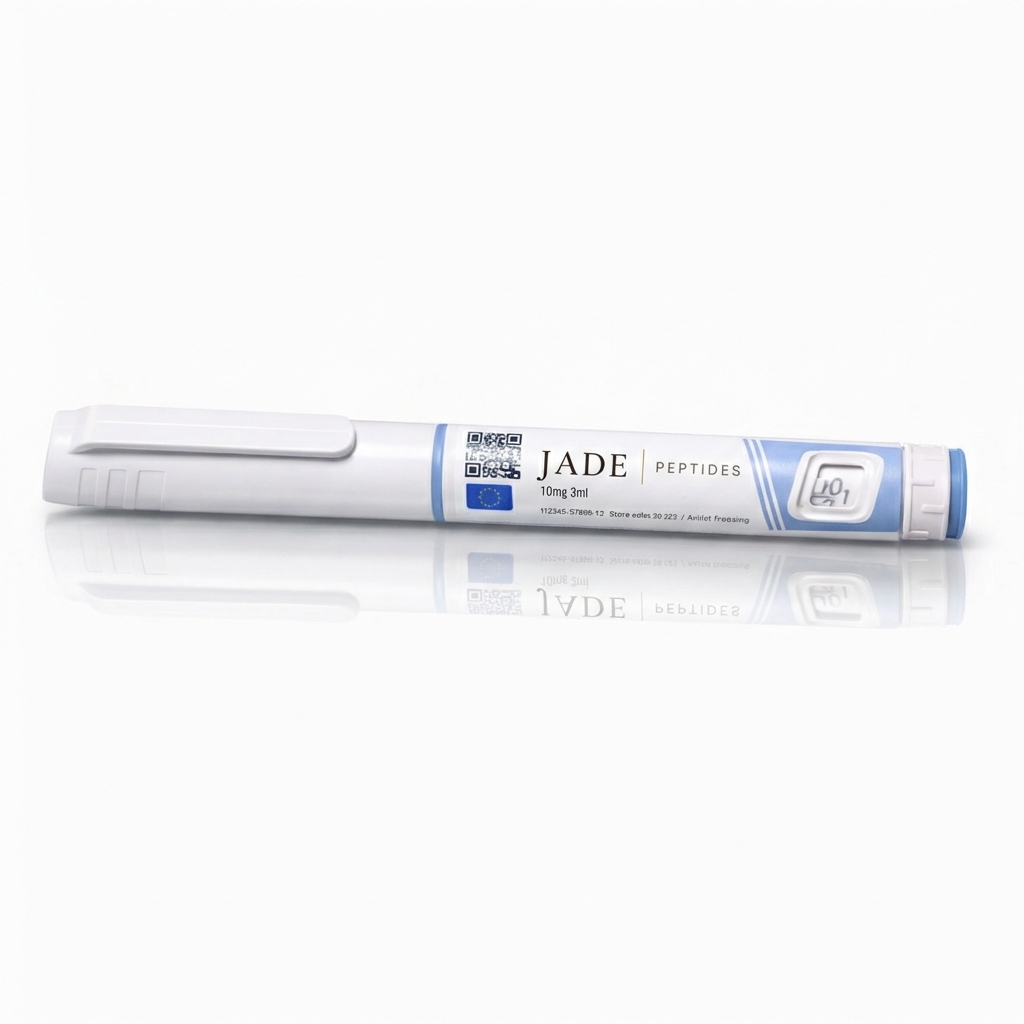
Pen vs. vial, quality criteria, safety and red flags – the honest buying guide for BPC-157, TB-500, GHK-Cu and other peptide pens.
Table of Contents
- Why the Peptide Pen Is the Future
- Pen vs. Vial: The Honest Comparison
- The Risks of Research-Grade Vials
- Quality Criteria: What to Look For
- The 10-Point Checklist Before You Buy
- How a Peptide Pen Works
- The Jade Peptides Standard
- FAQ: Frequently Asked Questions
The peptide market is booming. From BPC-157 to TB-500 to GHK-Cu – more and more people are looking for ways to safely and effectively use regenerative peptides. But with growing interest comes growing confusion: vials, lyophilisates, research chemicals, pre-filled pens – what is safe, what is reputable, and what is the best option?
This guide gives you the honest answer. Based on current FDA reports, media investigations by AP and the Washington Post, and clinical quality standards, we show you what really matters when buying a peptide pen.
1. Why the Peptide Pen Is the Future
The peptide pen is not a new concept – it is the logical evolution of a proven principle. Insulin pens revolutionised diabetes treatment decades ago by replacing complicated syringe-and-vial procedures with a simple, precise device. Today, over 300 million people worldwide use pen injectors for insulin, GLP-1 agonists (Ozempic, Wegovy), growth hormones and other peptide therapies.
The advantages are identical for regenerative peptides such as BPC-157, TB-500 and GHK-Cu:
| Feature | Value |
|---|---|
| Dosing accuracy | 0.01 mL |
| Reconstitution errors | 0% |
| Needle gauge | 30G–32G ultra-fine |
| Injection time | ~5 sec. |
2. Pen vs. Vial: The Honest Comparison
| Criterion | Vial + Syringe (traditional) | Peptide Pen (modern) |
|---|---|---|
| Preparation | Manual mixing of lyophilisate + bacteriostatic water | Pre-filled and ready to use – no reconstitution needed |
| Dosing | By hand with insulin syringe – error-prone | Precise dial-click mechanism (0.01 mL steps) |
| Contamination | Each puncture of the rubber stopper = risk | Closed system minimises risk |
| Stability | Decreases after reconstitution (cold chain critical) | Optimised formulation for maximum stability |
| Application | Multi-step: powder → water → mix → draw → inject | One-step: attach needle → select dose → inject |
| Comfort | Visible syringe, needle anxiety | Discreet design, barely visible needle, virtually painless |
| Disposal | Multiple needles, syringes, vials | Compact and travel-friendly |
3. The Risks of Research-Grade Vials
Before we discuss quality criteria, we need to address the elephant in the room: the grey market for "Research Only" peptides, which according to AP, the Washington Post and US News has grown explosively in recent years.
What "Research Only" Really Means
Peptides labelled "For Research Purposes Only" are explicitly not approved for human use. This label is not a quality designation – it is a legal disclaimer that manufacturers use to circumvent FDA regulations. The consequences are real: no purity guarantee, no sterile manufacturing, no dosing certainty.
The problem is well documented. Investigations of online peptides revealed significant deviations in content and purity – some samples contained no active ingredient at all. Others were contaminated with bacteria, heavy metals or endotoxins. The medical literature contains reports of serious infections from contaminated injectable peptides, requiring prolonged antibiotic therapy or hospitalisation.
The FDA itself emphasises that even a contamination of just 0.5% of the total substrate must be fully characterised and justified as safe – a standard that research-grade products structurally cannot meet.
The irony of FDA regulation: By banning legal compounding in the US, patients are paradoxically driven into the unregulated grey market, where quality risks are actually greater. EU-manufactured peptide pens under pharmaceutical standards offer a way out of this dilemma.
4. Quality Criteria: What to Look For
Purity & Analytics
Pharmaceutical peptides must achieve a purity threshold of at least 95% – ideally above 98%. Purity is determined by HPLC analysis (High-Performance Liquid Chromatography) and documented in a Certificate of Analysis (CoA).
Manufacturing Standards
The crucial difference lies in manufacturing. GMP (Good Manufacturing Practice) and ISO-certified laboratories work under controlled conditions: clean rooms, sterilised equipment, documented processes. Research chemical manufacturers often operate without comparable controls – no clean rooms, no sterilisation protocols, no external oversight.
Stability Data
Peptides are sensitive molecules. Temperature, light and oxidation can destroy their efficacy. Reputable manufacturers conduct stability tests and provide clear storage and shelf-life information. Products without this information may already be ineffective at the time of purchase.
5. The 10-Point Checklist Before You Buy
Check these 10 points before buying a peptide pen:
- Certificate of Analysis (CoA) available? Independent HPLC analysis with batch number and purity level (≥98%).
- EU or GMP-certified manufacturing? Pharmaceutical standards rather than "research lab" without certification.
- Clear dosing information? Exact μg/click or mg/mL specifications on the packaging.
- Transparent company information? Legal notice, physical address, reachable customer service – no anonymous web shops.
- Understand the "Research Only" label? In the EU, the designation "for research purposes only" is a regulatory requirement for peptides not approved as pharmaceuticals. What matters is not the label itself, but the quality behind it: EU manufacturing, HPLC certificates of analysis and pharmaceutical standards distinguish reputable suppliers from questionable grey market products.
- Sterility certification? Sterility test results or sterile manufacturing in clean room environment documented.
- Expiry date & storage instructions? Temperature specifications (typical: 2–8°C) and expiry date present.
- Compatible needles? Standard pen needles (30G–32G) per ISO 11608-2 – no proprietary systems.
- Realistic prices? Suspiciously cheap offers indicate inferior raw materials or missing quality control.
- Medical consultation recommended? Reputable suppliers emphasise the importance of medical supervision – not just quick sales.
6. How a Peptide Pen Works
Using a peptide pen is intuitive and follows a proven process identical to insulin and GLP-1 pens:
| Step | Action | Description |
|---|---|---|
| 01 | Attach needle | Screw or click on standard pen needle (30G–32G). Remove protective cap. |
| 02 | Set dose | Select desired dose using dial-click mechanism. Tactile and audible feedback confirms the setting. |
| 03 | Prepare injection site | Abdomen (around the navel) or thigh. Disinfect the area with an alcohol swab. |
| 04 | Inject | Position pen perpendicularly, press button, hold for 5–10 seconds. Withdraw needle, dispose. |
The entire process takes under one minute. The ultra-fine needles (30G–32G) are barely noticeable – most users describe the injection as virtually painless. After each injection, dispose of the needle in an approved sharps container.
7. The Jade Peptides Standard
At Jade Peptides, we have deliberately chosen pharmaceutical peptide pens over the vial market – out of conviction, not convenience. Our standard:
EU Manufacturing — All peptides are manufactured in EU-certified facilities under pharmaceutical standards. No research labs, no grey areas.
Purity of 98%+ with HPLC Analysis — Every batch is independently analysed by HPLC. Certificate of Analysis available on request for every order.
Pre-filled Pen Technology — No reconstitution, no dosing errors. Precise click-dosing in 0.01 mL steps. Compatible with standard pen needles.
Optimised Stability — Formulated for maximum shelf life. Clear storage and temperature information on every package.
Medical supervision recommended — We emphasise the importance of medical guidance. Our questionnaire supports physicians in creating individual protocols.
Ready for pharmaceutical peptide quality? BPC-157, TB-500, GHK-Cu and more – as pre-filled pens in EU quality. Discover Peptide Pens →
8. Frequently Asked Questions (FAQ)
What exactly is a peptide pen?
A peptide pen is a pre-filled injection device for the subcutaneous administration of peptides. The principle is identical to insulin pens: the peptide solution is already contained in the pen, and dosing is done via a precise dial-click mechanism. No manual mixing or reconstitution needed.
Why are peptide pens better than vials?
Three main reasons: First, pens eliminate contamination risk during reconstitution. Second, they offer more precise dosing than manual syringes (0.01 mL steps). Third, they are more stable because the formulation is optimised and the system is closed. Plus, they are significantly easier to use.
Are peptide pens painful?
Most users describe the injection as virtually painless. The pen needles used (30G–32G) are ultra-fine – thinner than a human hair. The subcutaneous injection into the abdomen or thigh takes only a few seconds.
How do I recognise a reputable peptide pen supplier?
Look for: EU or GMP manufacturing, available analysis certificates (CoA with HPLC), transparent legal notice, no "Research Only" labels, clear dosing information and reference to medical supervision. If these points are missing, exercise caution.
Do I need to refrigerate the peptide pen?
Yes, as a rule peptide pens should be stored at 2–8°C in the refrigerator (do not freeze). Bring to room temperature briefly before use. Exact specifications can be found on the packaging of your specific product.
Do I need a prescription for a peptide pen?
The regulatory situation varies by country. In the EU, most regenerative peptides are not approved as medicines but are also not classified as controlled substances. We generally recommend consulting a physician before starting any peptide therapy.
Which peptide pens does Jade Peptides offer?
Our range includes BPC-157, TB-500, the Wolverine Stack (BPC-157 + TB-500 combination) and GHK-Cu – all as pre-filled pens in EU quality. Visit our shop for the current range and availability.
Sources & References
- Associated Press / US News. "Americans are injecting themselves with unproven peptides." November 2025.
- Washington Post. "Peptide trend poses concerns over unapproved products." November 2025.
- Safe Harbor Group. "FDA's Overreach on Compounded Peptides." February 2026.
- Natura Dermatology. "Is BPC 157 Legal? Understanding Its Status." October 2025.
- Aspire Rejuvenation. "Which Peptides Are Safe? A Guide To Quality Standards." January 2026.
- MedX.it. "Are peptides safe? Risks, regulations, and what to know." November 2025.
- Ypsomed AG. "Pen Injectors for GLP-1, Insulin & Peptide Therapies." Technical Specifications 2025.
- FDA Guidance. "Bulk Drug Substances – Category 2." Peptide quality requirements and contamination thresholds.
- PMC / J Peptide Sci. "Regulatory Guidelines for Therapeutic Peptides and Proteins." 2025.
Disclaimer: This article is for informational and educational purposes only. The use of peptides should always be under medical supervision. Jade Peptides recommends working with qualified physicians for all health decisions. The regulatory situation varies by country – please inform yourself about applicable regulations in your jurisdiction.